
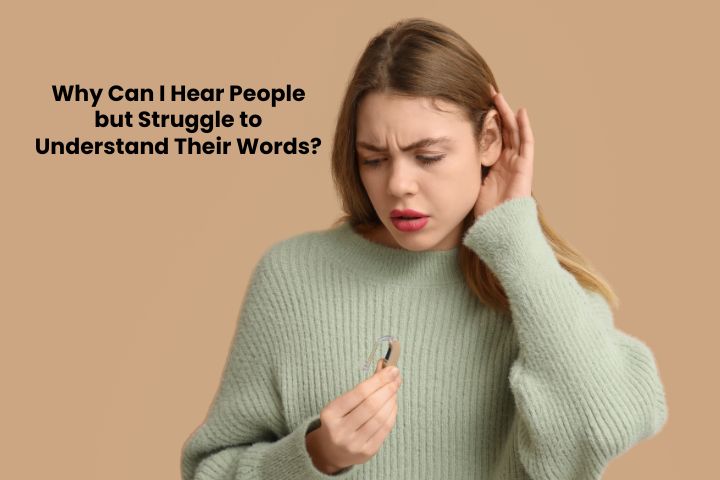
Why Can I Hear People but Struggle to Understand Their Words?
Introduction
Have you ever found yourself asking someone to repeat what they said, even though you could clearly hear their voice? Perhaps you can hear people speaking across a room, follow conversations when it is quiet, or listen to the television without difficulty. However, when someone speaks quickly or there is background noise, their words seem unclear.
If you can hear people but struggle to understand their words, it may be more than a concentration problem.
Hearing sounds and understanding speech are two different processes. Your ears receive sound, but your auditory system also needs to distinguish speech sounds, recognise individual words and interpret what someone is saying. When any part of this process is affected, conversations can become difficult even if voices sound loud enough.
One common reason is hearing loss, particularly when it affects the frequencies that help distinguish consonants and other speech details. Other factors, including background noise, auditory processing difficulties and certain ear conditions, may also contribute.
At Eljay Hearing Centre, with 50 years of expertise and 8 branches across Chennai, hearing assessments help identify why someone may be experiencing difficulty understanding conversations and what steps can improve their hearing and communication.
Let’s understand why this happens, which signs to look out for and when you should consider a professional hearing test.
Why Can You Hear People but Not Understand Their Words?
Hearing is not simply about detecting sound. It also involves recognising and interpreting the different elements that make up speech.
For example, you may hear someone saying a sentence but miss certain consonants, endings or softer syllables. As a result, their speech may sound muffled, unclear or as though they are mumbling.
This can happen because:
- Certain speech frequencies are not reaching your ears clearly.
- Background sounds are masking important parts of speech.
- Your ears are not transmitting sound information effectively.
- Your auditory system is having difficulty processing complex sounds.
- You are experiencing listening fatigue from constantly trying to follow conversations.
In some cases, a person may have relatively normal hearing thresholds during a basic hearing test but still struggle with speech understanding in everyday environments. This is why assessing speech clarity, and not just the ability to hear tones, is important.
7 Common Reasons You Can Hear People but Struggle to Understand Them
Several factors can affect how clearly you understand spoken words. Here are some of the most common reasons.
1. High-Frequency Hearing Loss
One of the common reasons people can hear voices but struggle to understand words is high-frequency hearing loss.
Speech contains different sound frequencies. While vowels generally carry much of the energy that makes speech sound loud, many consonants, including sounds such as ‘s’, ‘f’, ‘th’ and ‘t’, contain important high-frequency information.
When these frequencies become harder to hear, you may:
- Hear that someone is speaking but miss individual words.
- Find that people sound as though they are mumbling.
- Confuse words that sound similar.
- Struggle to follow conversations, particularly with unfamiliar speakers.
- Have difficulty understanding children or people with higher-pitched voices.
Age-related hearing loss, also known as presbycusis, often affects higher frequencies first. However, high-frequency hearing loss can also be associated with prolonged exposure to loud noise and other causes.
Read more about how to know if you have hearing loss.
2. Difficulty Hearing in Background Noise
Do you understand conversations easily when speaking to someone one-on-one but struggle in restaurants, family gatherings, meetings or crowded places?
This may indicate difficulty understanding speech in background noise.
Your auditory system normally helps you focus on one person’s voice while filtering out other sounds. When hearing is reduced, distinguishing the main speaker from surrounding noise can become more challenging.
Common situations include:
- Struggling to follow conversations at weddings or parties.
- Missing words when several people are talking together.
- Finding it difficult to understand someone in a crowded restaurant.
- Asking people to repeat themselves during meetings.
- Understanding conversations better in quiet rooms.
Background noise can make an existing hearing difficulty more noticeable. However, persistent problems in noisy environments can also occur when a basic hearing test appears normal, so further assessment may sometimes be needed.
3. Age-Related Hearing Loss
Age-related hearing loss develops gradually and may go unnoticed for years.
As people grow older, changes in the inner ear and auditory system can affect the ability to detect certain sounds and understand speech clearly.
Some common signs include:
- Feeling that people are speaking unclearly.
- Frequently asking family members to repeat themselves.
- Increasing the television volume.
- Struggling to understand conversations over the phone.
- Avoiding group conversations because following them feels tiring.
Many people assume these changes are simply a normal part of ageing. However, difficulty understanding speech should not be ignored.
A hearing test can help identify age-related hearing loss and determine whether hearing aids or other management options may help.
4. Earwax Build-Up or Middle Ear Problems
Not every hearing difficulty is caused by permanent damage to the inner ear.
A build-up of earwax can block the ear canal and make sounds seem muffled. Similarly, middle ear infections, fluid accumulation or problems affecting the movement of the eardrum and middle ear bones can interfere with sound transmission.
You may experience:
- A blocked or full sensation in the ear.
- Muffled hearing.
- Difficulty hearing conversations clearly.
- Ear discomfort or pain.
- Ringing sounds in the ear.
These conditions may cause conductive hearing loss and can sometimes be treated depending on the underlying cause.
Avoid inserting cotton buds or other objects into your ears to remove wax. If you experience persistent blocked hearing, consult an ENT specialist or hearing professional for an appropriate assessment.
You can also read: Why Is One Ear Blocked? Common Causes and When to Seek Help.
5. Noise-Induced Hearing Loss
Regular exposure to loud sounds can damage the delicate structures inside the inner ear.
This may happen due to:
- Listening to music at high volumes through earphones.
- Attending frequent concerts and loud events.
- Working in noisy industrial environments.
- Exposure to loud machinery or construction noise.
- Repeated exposure to loud wedding music, DJs and fireworks.
Noise-induced hearing loss can affect the ability to distinguish speech sounds, particularly in environments where several sounds compete for attention.
A person may continue hearing voices but struggle to understand what is being said.
If you have noticed muffled hearing or ringing after exposure to loud noise, do not automatically assume the symptoms will disappear. Sudden or significant hearing changes need prompt medical assessment.
Read more: Hearing Loss After a Loud Event.
6. Auditory Processing Difficulties
Sometimes, people have difficulty understanding speech even when their basic hearing thresholds are within the normal range.
This may involve difficulties with auditory processing, which refers to how the brain interprets and makes sense of sounds received through the ears.
For example, a person may:
- Hear someone speaking but struggle to follow the complete sentence.
- Find it difficult to understand rapid speech.
- Have trouble following conversations when multiple people are talking.
- Frequently misunderstand spoken instructions.
- Feel mentally exhausted after long conversations.
Auditory processing difficulties can have several possible explanations. They are not automatically the same as hearing loss, and similar symptoms can occur for other reasons.
A specialist may recommend additional assessments depending on the person’s age, symptoms and hearing test results.
7. Listening Fatigue and Difficulty Concentrating
Following a conversation requires attention and mental effort. When you constantly struggle to identify words, your brain may need to work harder to understand what someone is saying.
This can lead to listening fatigue.
You may notice that:
- Conversations feel exhausting, especially towards the end of the day.
- You lose track of what people are saying.
- You find it harder to follow long discussions.
- You feel more comfortable speaking to one person than a group.
- You struggle to concentrate when there are multiple sounds around you.
Tiredness, distractions and poor listening conditions can affect speech understanding. However, recurring difficulty following conversations should not automatically be dismissed as a concentration issue.
It is worth checking whether an underlying hearing difficulty is contributing to the problem.
Signs That You May Have a Speech Understanding or Hearing Problem
Difficulty understanding speech can develop gradually. Many people adapt to it without realising that their hearing has changed.
Look out for these common signs:
- You frequently ask people to repeat themselves: You hear the conversation but miss certain words.
- People sound like they are mumbling: Their voices are audible, but the words lack clarity.
- You struggle in crowded places: Restaurants, meetings and family gatherings become difficult.
- You hear better in quiet environments: One-on-one conversations are easier than group discussions.
- You confuse similar-sounding words: Certain consonants and word endings are difficult to distinguish.
- You turn up the television volume: Other people may find the volume unnecessarily loud.
- You struggle with phone conversations: Without visual cues, understanding speech becomes harder.
- You feel tired after conversations: Constantly concentrating on speech can become exhausting.
- You avoid social situations: Group conversations may feel frustrating or uncomfortable.
If several of these signs sound familiar, consider scheduling a professional hearing evaluation.
Can You Have Difficulty Understanding Speech Even With Normal Hearing?
Yes. Some people experience difficulty understanding spoken words even when their conventional pure-tone hearing test results fall within the normal range.
A standard pure-tone audiometry test measures the softest sounds a person can detect at selected frequencies. It does not measure every aspect of speech understanding in everyday situations.
For example, someone may detect tones clearly in a quiet testing environment but struggle to understand conversations in a noisy restaurant.
Depending on the symptoms, an audiologist may recommend additional assessments, such as:
- Speech audiometry.
- Word recognition testing.
- Speech-in-noise testing.
- Tympanometry.
- Further auditory processing assessment, where appropriate.
This is why a comprehensive hearing evaluation is important when someone reports persistent communication difficulties, even if they believe their hearing is normal.
How Is Difficulty Understanding Speech Diagnosed?
If you can hear people but struggle to understand their words, a professional hearing assessment can help identify the possible cause.
At Eljay Hearing Centre, a hearing evaluation may involve several tests depending on the individual’s symptoms and clinical requirements.
1. Pure Tone Audiometry
Pure tone audiometry is one of the most commonly used hearing tests.
It measures the softest sounds you can hear at different frequencies and helps determine:
- Whether hearing loss is present.
- The degree of hearing loss.
- Which frequencies are affected.
- Whether the hearing loss is conductive, sensorineural or mixed.
The results are recorded on an audiogram, which helps the audiologist understand your hearing profile.
2. Speech Audiometry
Speech audiometry evaluates how well you can hear and recognise spoken words.
Unlike a pure-tone hearing test, this assessment focuses on speech understanding.
It can help identify whether you are able to recognise words clearly when they are presented at an appropriate volume.
3. Speech-in-Noise Testing
If you find it difficult to understand conversations in crowded places, speech-in-noise testing may be particularly useful.
This assessment evaluates how well you can recognise speech when background noise is present.
It can help explain why you may understand someone perfectly in a quiet room but struggle in a restaurant, office or family gathering.
4. Tympanometry
Tympanometry evaluates the movement of the eardrum and provides information about middle ear function.
It can help identify issues such as middle ear fluid or pressure-related problems that may affect hearing.
The audiologist will recommend appropriate tests based on your symptoms and initial findings.
How Can You Improve Speech Understanding?
The right approach depends on why you are struggling to understand spoken words.
There is no single solution for everyone, which is why identifying the underlying cause is important.
Some possible management options include:
Hearing Aids
If hearing loss is responsible for poor speech clarity, appropriately selected and programmed hearing aids may help.
Modern hearing aids can be adjusted to amplify sounds according to an individual’s hearing profile. Depending on the device and the person’s needs, features such as directional microphones and noise management may also improve listening comfort in challenging environments.
Eljay Hearing Centre provides hearing aid consultation, fitting and programming support for suitable candidates, including hearing aid options from brands such as Widex, ReSound, Phonak and Signia.
The right hearing aid should be selected based on the hearing test results, lifestyle, communication requirements and professional recommendation.
Treating Underlying Ear Conditions
If the difficulty is caused by earwax build-up, an infection or a middle ear condition, appropriate medical treatment may improve hearing.
The treatment depends on the diagnosis. Avoid self-treating persistent ear blockage or using ear drops without appropriate advice.
Communication Strategies
A few simple changes can make conversations easier:
- Move closer to the person speaking.
- Choose quieter places for important conversations.
- Face the speaker so you can use visual cues.
- Reduce background television or music.
- Ask people to speak clearly rather than simply louder.
- Request that important information be repeated or written down.
- Choose seating that allows you to hear the main speaker comfortably.
These strategies can be useful alongside professional hearing care.
Auditory Rehabilitation and Follow-Up
Some individuals may benefit from communication training, auditory rehabilitation or follow-up support.
If hearing aids are recommended, regular adjustments and programming can help improve comfort and performance as you adapt to them.
When Should You Get a Hearing Test?
You should consider a hearing test if difficulty understanding speech is becoming frequent or affecting your everyday communication.
Do not wait until you can no longer hear sounds clearly. Early hearing assessments can help identify changes before they begin to significantly affect your daily life.
Consider scheduling a hearing evaluation if:
- You frequently misunderstand conversations.
- You struggle to hear people in noisy environments.
- You regularly ask others to repeat themselves.
- You find phone conversations difficult.
- You experience persistent ringing in your ears.
- Your family members notice that you are not responding to conversations.
- You have a history of prolonged noise exposure.
- You notice a change in hearing in one or both ears.
Important: If hearing suddenly decreases, particularly in one ear, seek urgent medical assessment. Sudden sensorineural hearing loss is time-sensitive and should not be treated as an ordinary hearing difficulty or delayed while waiting for a routine appointment.
Get Your Hearing Checked at Eljay Hearing Centre, Chennai
Being able to hear a person’s voice does not always mean you are hearing every word clearly.
If conversations have started feeling difficult, if people seem to mumble frequently or if you struggle to understand speech in noisy environments, it is worth getting your hearing evaluated.
At Eljay Hearing Centre, we offer professional hearing evaluation, hearing loss assessment, hearing aid consultation and personalised hearing care.
With 50 years of expertise and 8 branches across Chennai, Eljay Hearing Centre helps individuals understand their hearing concerns and explore suitable solutions.
Whether you need a routine hearing test, an assessment for speech clarity problems or guidance on hearing aids, the first step is understanding your hearing health.
Book your hearing test at Eljay Hearing Centre today.
Website: https://eljayhearing.com/
Appointments: https://appointment.eljayhearing.com/
At Eljay Hearing Centre, we provide advanced hearing aids from:
8 branches across Chennai: Or visit your nearest Eljay Hearing Centre in:
- Purasawalkam (Head Office): A1, 1st Floor, Garden Apartments, No.68, Purasawalkam High Road, Chennai – 600007
- Adyar: No.75, Dhanalakshmi Ave, near Nalli Silks, Kasturba Nagar, Chennai – 600020
- Abhiramapuram :Flat no 1 ,Ground Floor Alamelu Enclave, No 1, Abhiramapuram 4th street, Chennai 600018
- Ambattur: No.426/469, MM Tower, MTH Road, Opp. Rakki Cinemas, Behind Axis Bank, Chennai – 600053
- Nanganallur: No.14, 2nd Main Road, Ram Nagar, Near Anjaneyar Temple, Opp. Sidney Hospital, Chennai – 600061
- Tambaram (West): No.21, Duraisamy Reddy Street, Next to Passport Office, Chennai – 600045
- Velachery: No.26/15, Sai Ram Complex, 100-ft Road, next to Dr. Batra’s, Vijaya Nagar, Chennai – 600042
- Tondiarpet: No.71, O.No, 15/1, Kummalamman Koil St, opp. to KVT Maaligai, Sanjeevarayanpet, Tondiarpet, Chennai, Tamil Nadu 600081
 Book a consultation today: appointment.eljayhearing.com
Expert care is always within reach, wherever you are in Chennai.
👉 Book an appointment: https://appointment.eljayhearing.com/
🌐 Learn more: https://eljayhearing.com/
Frequently Asked Questions
1. Why can I hear someone talking but not understand what they are saying?
This may happen due to hearing loss, particularly high-frequency hearing loss, difficulty distinguishing speech from background noise or other auditory processing difficulties. A hearing assessment can help identify the possible reason.
2. Is difficulty understanding speech a sign of hearing loss?
Yes. Difficulty understanding speech, especially in noisy environments, is a common sign of hearing loss. Some people can detect voices but struggle to recognise individual words clearly.
3. Why do people sound like they are mumbling even when they speak loudly?
Certain frequencies and speech details may not be reaching your ears clearly. Increasing the volume does not always improve speech clarity, particularly when high-frequency hearing loss is involved.
4. Why can I understand conversations in quiet places but not in noisy environments?
Background noise can mask important speech sounds. Hearing loss can make it more difficult to separate a speaker’s voice from surrounding sounds, which is why conversations in restaurants, meetings and crowded places may become challenging.
5. Can I have normal hearing but still struggle to understand words?
Yes. A standard pure-tone hearing test does not measure every aspect of speech understanding. Some people may need speech audiometry, speech-in-noise testing or further assessment to investigate their difficulties.
6. Can high-frequency hearing loss affect speech clarity?
Yes. High-frequency sounds contribute important details to speech, particularly consonants. When these sounds are difficult to hear, words may seem unclear even when the speaker’s voice is audible.
7. Can hearing aids help if I can hear but cannot understand words?
If hearing loss is contributing to the problem, appropriately selected and programmed hearing aids may improve speech audibility and communication. The benefits depend on the type and degree of hearing loss, speech recognition ability and individual needs.
8. Does difficulty understanding speech always mean I need hearing aids?
No. Hearing aids are recommended only when appropriate for the individual’s hearing condition. Some problems may be related to earwax, middle ear conditions, listening environments or other auditory difficulties. A professional assessment helps determine the right approach.
9. Which hearing test checks how well I understand words?
Speech audiometry evaluates how well you recognise spoken words. Speech-in-noise testing may also be recommended if you struggle to understand conversations when background sounds are present.
10. Where can I get a hearing test in Chennai?
You can visit Eljay Hearing Centre for hearing evaluation and hearing care across its 8 branches in Chennai. Visit https://eljayhearing.com/ or book an appointment through https://appointment.eljayhearing.com/.